
In this guide
- 01What Is ISO 22000?
- 02What Is HACCP?
- 03ISO 22000 vs HACCP: Key Differences
- 04Understanding the Seven HACCP Principles
- 05What Additional Requirements Does ISO 22000 Include?
- 06Prerequisite Programmes in HACCP and ISO 22000
- 07Which System Is Better for Small Food Businesses?
- 08ISO 22000 vs HACCP for Food Exporters
- 09How Much Does ISO 22000 or HACCP Certification Cost?
- 10How to Choose the Right Food Safety Approach
- 11Frequently Asked Questions
- 12Conclusion
Introduction
Food safety is one of the most important responsibilities of any organisation involved in food manufacturing, processing, packaging, storage or distribution. Even a minor failure in handling or production can create serious consequences for consumer health, business reputation and regulatory compliance.
Two widely recognised approaches to food safety are ISO 22000 and HACCP. Although they share the objective of preventing food safety hazards, their scope, structure and implementation requirements are different.
Understanding ISO 22000 vs HACCP helps businesses select a system that matches their operations, regulatory responsibilities and customer expectations.
This guide explains how the two approaches work, their major differences, certification considerations and which option may be suitable for different types of food businesses.
What Is ISO 22000?
ISO 22000 is an international standard that specifies requirements for a Food Safety Management System (FSMS).
The current published edition is ISO 22000:2018, including its 2024 climate-action amendment. A further revision is under development.
It provides a framework for controlling food safety hazards through operational processes, management responsibilities, communication, performance evaluation and continual improvement.
ISO 22000 incorporates HACCP principles while adding broader management-system requirements.
Organisations exploring ISO 22000:2018 certification can use the standard to demonstrate that their food safety management system meets independently assessable requirements.
The standard is relevant to food manufacturers, processors, ingredient suppliers, packaging businesses, cold-storage providers, caterers and other organisations involved in the food chain.
What Is HACCP?
HACCP stands for Hazard Analysis and Critical Control Points.
It is a preventive food safety methodology designed to identify, evaluate and control significant biological, chemical and physical hazards.
Rather than relying solely on testing finished products, HACCP encourages businesses to assess hazards throughout the production process.
For example, a dairy manufacturer may identify microbial contamination as a significant hazard and establish validated control measures at relevant production stages.
HACCP principles are described in the Codex Alimentarius General Principles of Food Hygiene.
Businesses can explore HACCP assessment and certification support to understand available evaluation approaches.
Unlike ISO 22000, HACCP is not a standalone ISO management-system standard. Third-party HACCP certifications may be offered under different schemes, so businesses should confirm their customer or regulatory acceptance.
ISO 22000 vs HACCP: Key Differences
Comparison | ISO 22000 | HACCP |
Nature | International management-system standard | Preventive food safety methodology |
Primary objective | Manage food safety across the organisation | Identify and control significant food safety hazards |
Framework | Management system with HACCP principles | Seven HACCP principles and supporting application steps |
Management responsibilities | Explicit leadership and management-system requirements | HACCP implementation requires management support |
Internal audits | Required within the FSMS | Depend on applicable regulations or schemes |
Certification | Third-party management-system certification available | Scheme-based assessment or certification available |
Improvement | Formal continual-improvement requirements | Plan review, verification and updating |
Application | Organisations throughout the food chain | Food businesses and relevant food-handling processes |
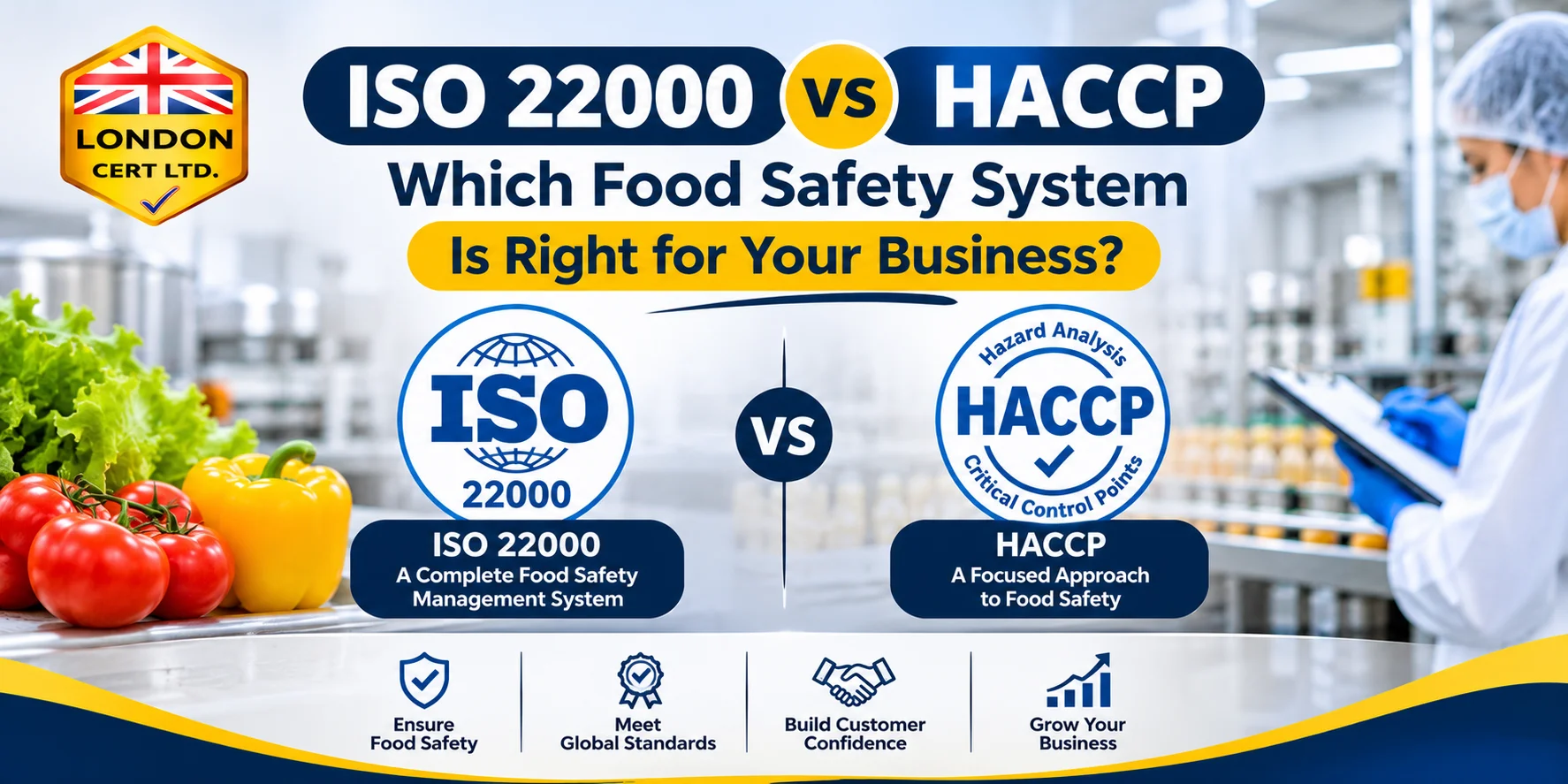
The central distinction is that ISO 22000 provides a broader organisational system while HACCP concentrates on food safety hazard identification and control.
Understanding the Seven HACCP Principles
The HACCP methodology is based on seven principles.
1. Conduct Hazard Analysis
Identify potential biological, chemical and physical hazards at relevant production stages.
2. Determine Critical Control Points
Identify the process steps where control is essential to prevent, eliminate or reduce significant hazards to acceptable levels.
3. Establish Validated Critical Limits
Determine measurable limits for critical control points using appropriate scientific, technical or regulatory evidence.
4. Establish Monitoring Procedures
Define how critical control points will be monitored, who is responsible and how often checks must occur.
5. Establish Corrective Actions
Determine the actions required when monitoring indicates that a critical limit has not been achieved.
6. Validate and Verify the HACCP System
Establish whether control measures are capable of managing hazards and verify that the system continues to operate effectively.
7. Maintain Documentation and Records
Retain appropriate evidence of hazard analysis, monitoring, deviations, corrective actions and verification.
These principles form the foundation of HACCP-based food safety management.
ISO 22000 builds upon them by introducing additional organisational requirements.
What Additional Requirements Does ISO 22000 Include?
ISO 22000 addresses several subjects beyond the core HACCP methodology.
Leadership and accountability: Management must establish a food safety policy, allocate responsibilities and ensure suitable resources are available.
Organisational context: Businesses must understand relevant internal and external issues and the needs of interested parties.
Communication: Food safety information must be communicated effectively within the organisation and, where relevant, throughout the food chain.
Prerequisite programmes: Organisations must establish the basic operational and hygiene conditions necessary for safe food production.
Performance evaluation: The FSMS must be assessed through appropriate monitoring, internal auditing and management review.
Continual improvement: Organisations must address nonconformities and improve the suitability, adequacy and effectiveness of the management system.
For food producers planning a more comprehensive certification strategy, London Cert's food-processing certification guidance provides additional industry-specific context.
Prerequisite Programmes in HACCP and ISO 22000
Prerequisite programmes, often called PRPs, are fundamental food safety practices.
They may include cleaning and sanitation, pest control, personnel hygiene, equipment maintenance, supplier controls and protection against contamination.
Both HACCP-based systems and ISO 22000 depend on effective prerequisite programmes.
ISO 22000 requires organisations to establish appropriate PRPs and integrate them into the FSMS.
The ISO 22002 family provides sector-specific information relevant to food safety prerequisite programmes.
Businesses should implement suitable hygiene and operational controls before assuming that a HACCP plan alone will manage every food safety risk.
Which System Is Better for Small Food Businesses?
The answer depends on the size, complexity and customer requirements of the organisation.
A small catering company may begin by establishing documented hygiene procedures, identifying significant hazards and implementing a proportionate HACCP-based system.
A food manufacturer supplying larger commercial buyers may benefit from the broader management-system framework of ISO 22000.
However, small businesses are not excluded from ISO 22000 certification.
The standard can apply to organisations of different sizes, provided the system appropriately reflects their operations.
The key consideration is whether the business needs an independently certified FSMS, a HACCP-based assessment or another food safety certification scheme.
ISO 22000 vs HACCP for Food Exporters
Export-oriented businesses frequently face additional customer, regulatory and supply-chain requirements.
A prospective buyer may request ISO 22000 certification, HACCP documentation or another specific food safety scheme.
Some large retailers may require FSSC 22000 rather than ISO 22000 alone.
These requirements are not interchangeable.
Food exporters should therefore obtain written confirmation of their buyer's expectations before choosing a certification pathway.
In addition, ISO 22000 or HACCP certification does not automatically replace food licences, product registrations or other legal requirements.
How Much Does ISO 22000 or HACCP Certification Cost?
The total cost depends on several factors:
Type of food products and production processes.
Number of facilities included in the assessment.
Organisational size and employee count.
Complexity of the identified food safety hazards.
Existing procedures and documented information.
Required audit arrangements and certification scope.
A small business with established procedures may require less implementation work than a multi-site manufacturer.
Organisations should request a quotation that clearly identifies the scope, applicable scheme, audit requirements and ongoing assessment obligations.
How to Choose the Right Food Safety Approach
Before selecting a certification route, ask five questions.
What food safety hazards exist within our operations?
Which legal requirements apply to our products and markets?
Do customers require a named certification standard or scheme?
Are our existing hygiene and monitoring systems effective?
Do we need a broader management system covering audits, leadership and continual improvement?
Answers to these questions can help management select a suitable approach without unnecessary expenditure.
Frequently Asked Questions
Is HACCP included in ISO 22000?
Yes. ISO 22000 incorporates HACCP principles within a broader Food Safety Management System.
Can a company implement HACCP without ISO 22000?
Yes. Businesses can apply HACCP principles independently, subject to applicable legislation and customer requirements.
Is ISO 22000 certification mandatory?
ISO 22000 is generally voluntary, although some contracts may require it. Food businesses must still comply with mandatory food safety regulations.
Is ISO 22000 the same as FSSC 22000?
No. FSSC 22000 is a separate certification scheme built around ISO 22000 and additional requirements.
Can HACCP and ISO 22000 be implemented together?
Yes. HACCP forms part of an effective ISO 22000 system, so the two approaches are complementary.
Conclusion
The comparison of ISO 22000 vs HACCP shows that both play important roles in effective food safety management.
HACCP concentrates on identifying and controlling significant hazards, while ISO 22000 provides a broader framework for managing food safety throughout an organisation.
The right choice depends on operational risks, customer expectations, applicable regulations and certification objectives.
Need help selecting the appropriate food safety certification pathway?
Explore London Cert's ISO 22000 certification services to understand assessment requirements and the next steps for your business.
London Cert Team
Verified Lead AuditorWritten and peer-reviewed by London Cert's senior assessment directorate. London Cert Ltd is an independent UK-registered registrar officially accredited by UASL (United Accreditation Services Limited) for management system certifications worldwide.