
In this guide
- 01What Is HACCP in Food Safety?
- 02Why Are the 7 Principles of HACCP Important?
- 03Principle 1: Conduct a Hazard Analysis
- 04Principle 2: Determine Critical Control Points
- 05Principle 3: Establish Validated Critical Limits
- 06Principle 4: Establish CCP Monitoring Procedures
- 07Principle 5: Establish Corrective Actions
- 08Principle 6: Validate the HACCP Plan and Verify the System
- 09Principle 7: Establish Documentation and Record Keeping
- 10Practical HACCP Example: Ready-to-Eat Food Production
- 11Steps to Implement HACCP in a Food Business
- 12HACCP vs ISO 22000: What Is the Difference?
- 13Common HACCP Implementation Mistakes
- 14Frequently Asked Questions
- 15Conclusion
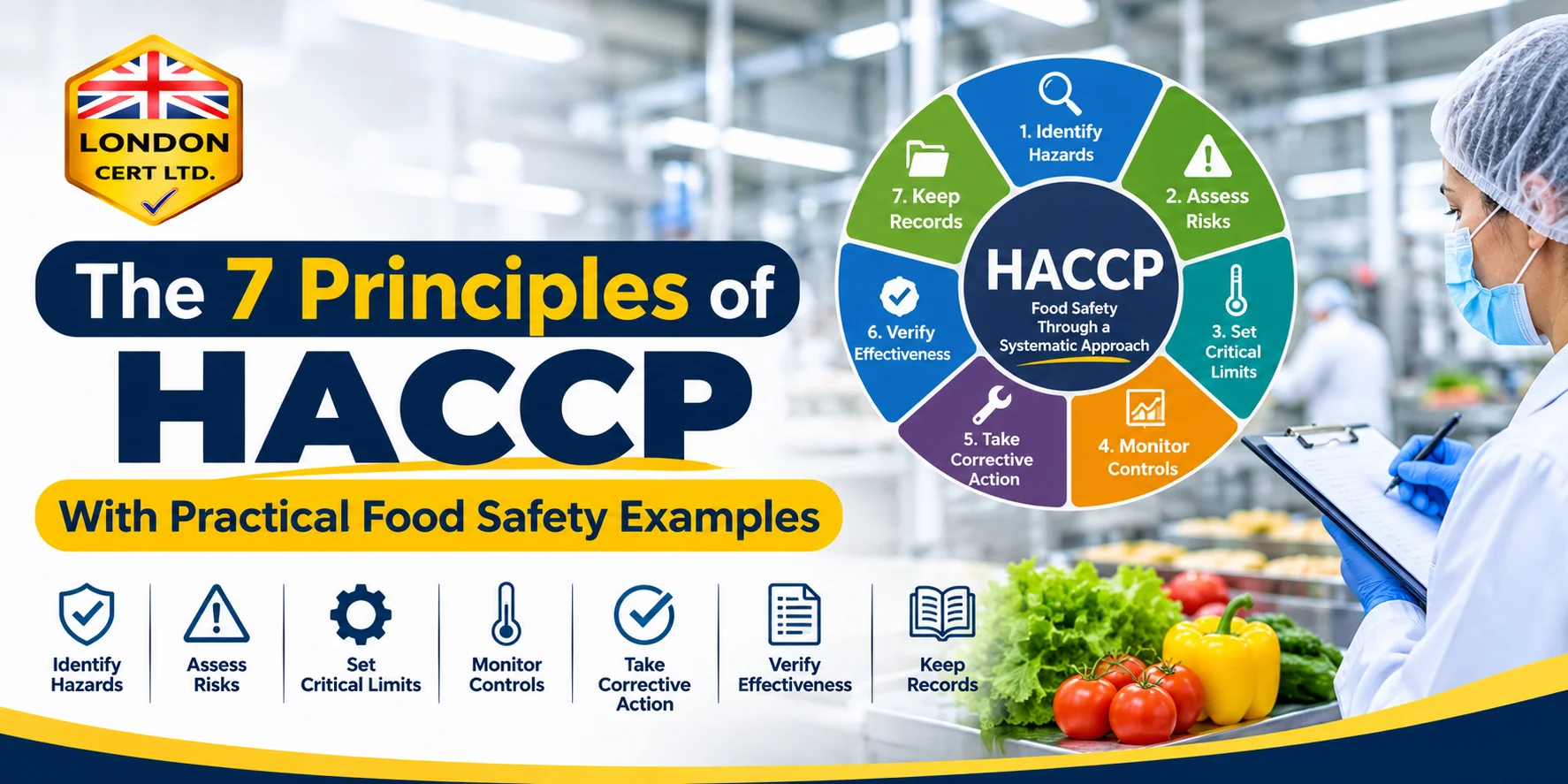
The 7 Principles of HACCP With Practical Food Safety Examples
Food safety is an essential responsibility for businesses involved in food manufacturing, processing, preparation, storage and distribution.
Even a small mistake in food handling can introduce biological, chemical or physical hazards that may affect consumer health.
To prevent these risks, food businesses need a systematic approach to identifying hazards and establishing effective controls.
This is where the 7 principles of HACCP play an important role.
HACCP stands for Hazard Analysis and Critical Control Points. It is a preventive food safety methodology that helps organisations identify significant hazards, determine necessary controls and verify that those controls work.
HACCP principles are described within the Codex Alimentarius General Principles of Food Hygiene and are widely used in food safety management.
This guide explains each principle with practical examples and outlines how businesses can develop an effective HACCP plan.
What Is HACCP in Food Safety?
HACCP is a structured approach to preventing food safety hazards rather than relying entirely on testing finished products.
The methodology examines food processes from receiving raw materials through production, storage, distribution and other relevant stages.
Its purpose is to identify significant hazards and ensure appropriate controls are established.
Businesses exploring independent HACCP assessment can review HACCP certification and determine which approach fits their operations and customer requirements.
HACCP is not itself an ISO management-system standard.
However, its principles are incorporated into broader food safety systems, including ISO 22000.
Why Are the 7 Principles of HACCP Important?
Food businesses encounter different types of hazards.
- Biological hazards may include harmful bacteria, viruses and parasites.
- Chemical hazards can involve allergens, cleaning chemicals, pesticide residues or other unwanted substances.
- Physical hazards may include glass fragments, metal pieces or other foreign materials.
HACCP helps businesses evaluate these hazards and decide which require specific control measures.
An effective system can improve process consistency, reduce the likelihood of unsafe products and strengthen food safety records.
The seven principles create a logical sequence for identifying, controlling, monitoring and reviewing significant food safety hazards.
Principle 1: Conduct a Hazard Analysis
The first HACCP principle is to identify potential food safety hazards associated with each relevant stage of production.
Businesses should evaluate the likelihood and severity of hazards and determine which are significant enough to require specific controls.
For example, a business producing ready-to-eat chicken products might identify hazards during raw material receiving, storage, cooking, cooling and packaging.
Possible hazards include microbial contamination, allergen cross-contact, chemical contamination and foreign materials.
The HACCP team should determine suitable control measures based on product characteristics, process conditions and relevant scientific information.
Not every hazard automatically becomes a Critical Control Point.
Some can be adequately managed through established Good Hygiene Practices or other prerequisite programmes.
Principle 2: Determine Critical Control Points
A Critical Control Point (CCP) is a step where control is essential to prevent, eliminate or reduce a significant food safety hazard to an acceptable level.
For example, a validated cooking step may be identified as a CCP when it is essential for controlling a significant biological hazard.
The HACCP team should assess the process and use appropriate decision-making methods to identify CCPs.
The number of CCPs depends on the product, hazards and production process.
A food business should not identify every process step as a CCP simply to demonstrate greater control.
Instead, CCP selection should be based on a defensible hazard analysis.
Principle 3: Establish Validated Critical Limits
Once CCPs have been identified, the next principle is to establish critical limits.
A critical limit distinguishes acceptable from unacceptable conditions at a CCP.
Depending on the process, it might involve temperature, time, pH, water activity or another measurable parameter.
Consider a cooking operation identified as a CCP.
The HACCP team must establish a suitable combination of temperature and time based on applicable regulations, scientific evidence and process validation.
The business should not adopt an arbitrary cooking temperature copied from an unrelated HACCP template.
Critical limits must be appropriate to the specific food product, identified hazard and operating conditions.
Principle 4: Establish CCP Monitoring Procedures
Monitoring determines whether a CCP remains under control.
Businesses should specify what will be measured or observed, how monitoring will take place, who is responsible and how frequently checks are required.
For a cooking CCP, monitoring might involve measuring product temperature using suitable equipment.
The procedure should establish how readings are recorded and what happens when a result falls outside the critical limit.
Monitoring arrangements need to identify deviations early enough for the organisation to take appropriate action.
Reliable monitoring records also help demonstrate that the HACCP plan has been followed.
Principle 5: Establish Corrective Actions
Corrective actions are required when monitoring shows that a CCP is not under control.
A food business must determine how to restore control, assess affected products and prevent potentially unsafe food from reaching consumers.
For example, if a cooking process does not meet its validated critical limit, the business should follow an established deviation procedure.
This may involve holding affected products, assessing their safety, determining whether further processing is appropriate and investigating the cause.
The organisation should document the deviation, actions taken and product disposition.
Corrective actions should address both the immediate issue and the underlying cause where necessary.
Principle 6: Validate the HACCP Plan and Verify the System
Validation and verification are related but different activities.
Validation establishes whether the control measures and HACCP plan are capable of controlling the identified hazards.
Verification determines whether the HACCP system has been implemented and is functioning as intended.
For example, validation may involve scientific evidence showing that a defined cooking process adequately controls a particular biological hazard.
Verification activities may include reviewing monitoring records, checking calibration arrangements, conducting internal audits and evaluating relevant test results.
Businesses should establish appropriate verification procedures and review the HACCP plan when significant changes occur.
Such changes may involve ingredients, processing equipment, packaging, operating conditions or new hazard information.
Principle 7: Establish Documentation and Record Keeping
The final HACCP principle involves maintaining appropriate documentation and records.
Records help businesses demonstrate that hazards have been assessed, controls are defined and monitoring activities are completed.
Typical HACCP documentation includes:
Product descriptions and intended use.
Process flow diagrams.
Hazard analysis records.
CCP determinations and supporting rationale.
Critical limits and validation evidence.
Monitoring procedures and results.
Corrective-action records.
Verification and review records.
Relevant employee training evidence.
Documentation should be proportionate to the nature and complexity of the food business.
A small food-processing operation may require a simpler system than a large factory operating several production lines.
The essential requirement is that records are accurate, accessible and useful for managing food safety.
Practical HACCP Example: Ready-to-Eat Food Production
Consider a business manufacturing a ready-to-eat cooked chicken product.
The following table illustrates how HACCP principles might be applied.
Process stage | Example hazard | Potential control |
Raw material receiving | Contaminated ingredients | Supplier approval and receiving controls |
Raw material storage | Microbial growth | Appropriate temperature management |
Preparation | Cross-contamination | Separation and hygiene controls |
Cooking | Survival of relevant pathogens | Validated cooking process |
Cooling | Microbial growth | Validated cooling arrangements |
Packaging | Post-process contamination | Hygienic handling and packaging controls |
This example demonstrates the importance of evaluating the complete production process.
The actual CCPs, critical limits and monitoring procedures must be determined through a product-specific hazard analysis.
These examples are not a ready-to-use HACCP plan and should not replace competent food safety assessment.
Steps to Implement HACCP in a Food Business
Codex guidance describes preparatory activities before applying the seven HACCP principles.
A practical starting sequence includes assembling a HACCP team, describing the product, identifying its intended use, preparing a process flow diagram and confirming that diagram on-site.
The team can then identify hazards and apply the seven principles systematically.
Businesses should ensure that prerequisite programmes are operating effectively before relying on a HACCP plan.
These may involve cleaning, pest control, maintenance, personal hygiene, supplier management and other basic food safety practices.
For manufacturers, the ISO 22002 family provides additional guidance on prerequisite programmes.
Companies can also explore ISO certification for food-processing businesses to understand the relationship between different food safety standards.
HACCP vs ISO 22000: What Is the Difference?
HACCP is a food safety methodology focused on identifying significant hazards and establishing preventive controls.
ISO 22000 is an international Food Safety Management System standard that incorporates HACCP principles within a broader management framework.
ISO 22000 also addresses leadership, organisational context, communication, performance evaluation and continual improvement.
Businesses that require a certifiable food safety management system can explore ISO 22000:2018 certification.
Choosing between HACCP-focused assessment and ISO 22000 certification depends on customer expectations, regulatory obligations, business complexity and intended markets.
Common HACCP Implementation Mistakes
One common mistake is copying a generic HACCP plan without analysing actual products and processes.
Another is identifying CCPs without sufficient justification.
Businesses may also establish critical limits without adequate validation or maintain monitoring records that do not reflect real operations.
Poorly defined corrective actions can create additional risks when deviations occur.
HACCP teams should regularly review the system and ensure that workers understand their responsibilities.
Frequently Asked Questions
What are the 7 principles of HACCP?
They are hazard analysis, CCP determination, establishing validated critical limits, monitoring, corrective actions, validation and verification, and documentation and record keeping.
Is HACCP certification mandatory?
Requirements depend on the country, type of food business and applicable customer or regulatory obligations. A separate HACCP certificate is not universally mandatory.
Can small food businesses implement HACCP?
Yes. HACCP principles can be applied to businesses of different sizes, with procedures proportionate to their operations and food safety risks.
Is HACCP the same as ISO 22000?
No. HACCP focuses on hazard analysis and control, while ISO 22000 specifies requirements for a broader Food Safety Management System.
Conclusion
Understanding the 7 principles of HACCP helps food businesses move from reactive quality checks to preventive food safety management.
By identifying significant hazards, establishing appropriate controls, monitoring critical points and maintaining reliable records, organisations can improve their ability to produce safe food.
Effective HACCP implementation depends on accurate hazard analysis, validated controls and ongoing verification.
Looking to strengthen your food safety processes?
London Cert provides guidance on HACCP assessment and related food safety certification pathways. Explore HACCP certification and assessment services to identify a suitable approach for your business.
London Cert Team
Verified Lead AuditorWritten and peer-reviewed by London Cert's senior assessment directorate. London Cert Ltd is an independent UK-registered registrar officially accredited by UASL (United Accreditation Services Limited) for management system certifications worldwide.